What the Highway 92 Commute Costs a Half Moon Bay Buyer
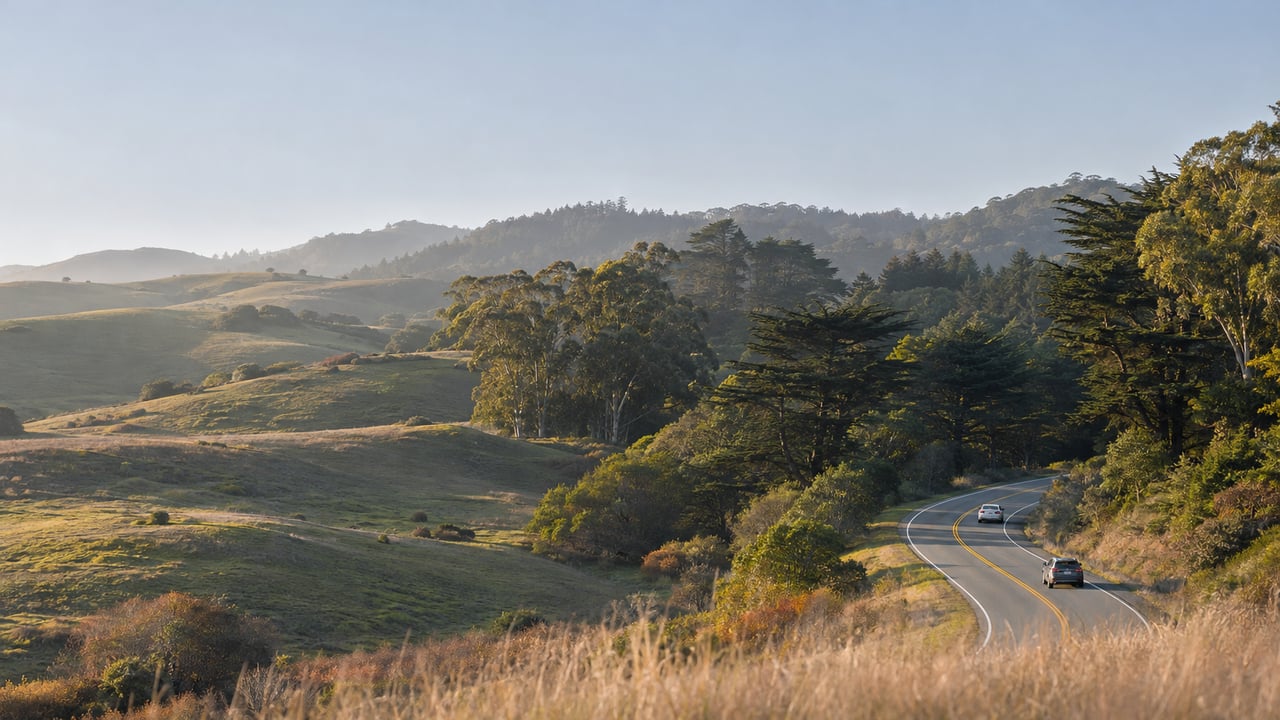
In October 2026, a single-family home in Half Moon Bay sold for a median $872 per square foot. In San Mateo, over the hill on the other end of State Route 92, the figure was $1,356. That $484 gap is the closest thing the Coastside has to a sticker price for the road. When you buy in Half Moon Bay and keep a Peninsula job, the discount pays you for driving that road. The county's traffic counts show a road whose busiest hours include Saturday afternoon as well as the weekday rush. They also show a weekday commute in the Coastside direction that moves better than its reputation.
This post puts the October sales figures beside the San Mateo County traffic measurements so you can see what the discount covers.
The San Mateo County Association of Realtors October 2026 report, released November 12, gives these single-family figures for October:
| City | Median sale price | Median $/sq ft | % of list received | Avg days on market | Months of inventory |
|---|---|---|---|---|---|
| Half Moon Bay | $1,674,000 | $872 | 102% | 41 | 3.8 |
| San Mateo | $2,375,500 | $1,356 | 108% | 15 | 1.2 |
| Redwood City | $2,455,000 | $1,413 | 109% | 18 | 1.3 |
| Burlingame | $3,510,000 | $1,629 | 109% | 20 | 0.7 |
Half Moon Bay closed 8 single-family sales in October. The average sale price that month was $2,555,137, well above the $1,674,000 median. With a sample that small, the per-square-foot figure is the steadier comparison. The average Half Moon Bay home sold in October was 1,996 square feet. At San Mateo's October rate, that house would have cost about $966,000 more. Against Redwood City the gap per square foot was $541, and against Burlingame it was $757.
The other columns tell you how deals go. October buyers in San Mateo paid 108% of list on average after 15 days. In Half Moon Bay they paid 102% after 41 days, with 3.8 months of inventory against San Mateo's 1.2. On the Coastside, the months of inventory leave a buyer more time to decide and less pressure to bid far over asking. Some of that slack comes from the same road that produces the price gap.
Every two years, C/CAG, the City/County Association of Governments of San Mateo County, measures congestion on the county's major roads. Its 2025 Congestion Management Program monitoring report rates SR-92 from Highway 1 to Interstate 280 at level of service E in both the morning and evening weekday peaks. The 2023 report gave the same rating. The counts behind it were taken on midweek days in April, May and August 2025, with holidays and special events left out.
The peak-hour volumes show the commuter flow. In the 2025 counts, 1,106 vehicles headed east over the hill in the morning peak hour, against 692 heading west. In the evening, 1,256 came back west and 802 went east. A Half Moon Bay resident who works on the Peninsula drives with the heavier flow both ways. The eastbound grade has had help for a long time. The San Mateo County Transportation Authority finished a continuous 1.8-mile uphill climbing lane between SR-35 and Pilarcitos Creek in fall 2000.
East of I-280, where SR-92 becomes a freeway down to US-101, C/CAG measures average speeds rather than ratings. In the 2025 counts, eastbound traffic averaged 47 mph in the morning peak and westbound traffic averaged 53 mph in the evening peak, against a free-flow speed of 60. Those are the directions a Coastside commuter drives: east toward San Mateo in the morning and west toward home in the evening.
The slow direction is eastbound in the evening, which averaged 20 mph in 2025, down from 26 mph in 2023. For a Half Moon Bay household, that matters for an evening trip toward 101, a dinner in San Mateo or a run to the San Mateo Bridge, more than for the daily commute. Caltrans' roughly $50 million US-101/SR-92 Interchange Short Term Area Improvements started construction in spring 2025, with completion expected in summer 2028.
The Highway 1/SR-92 intersection is where every Half Moon Bay commute starts. Its modeled weekday delay dropped between C/CAG's last two reports, from 53.6 seconds in the morning and 49 seconds in the evening in 2023 to 27.9 and 34.6 seconds in 2025. That moved it from level of service D to C. Main Street at SR-92 modeled at 42.0 seconds in the 2025 morning peak and 32.7 seconds in the evening peak.
The work along Highway 1 isn't finished. Caltrans' $46.7 million SR-1 Multi-Asset Roadway Rehabilitation Project between Moss Beach and Half Moon Bay is scheduled to run from fall 2025 to summer 2027, and its August 2026 update had signal upgrades underway through the end of 2026. Earlier in the project, in June 2026, Caltrans ran nighttime work at the SR-1/SR-92, Main Street and Kelly Avenue intersections. Separately, the Transportation Authority lists the City of Half Moon Bay's Highway 1 project from Main Street to Kehoe Avenue as planned for construction in 2026. It would add a signal at Highway 1 and Terrace Avenue, extend frontage roads and build a multi-use path. If you're touring homes this winter, allow some slack for lane closures along Highway 1.
C/CAG also measures Saturday conditions, and the rating for SR-92 from Highway 1 to I-280 is E in all three periods it tracks: morning, midday and afternoon, in both 2025 and 2023. On the two-lane road, a Saturday is rated the same as a weekday peak.
In places, Saturday rates worse. The Highway 1/SR-92 intersection modeled 40.5 seconds of delay on a 2025 Saturday afternoon, against 34.6 seconds in the weekday evening peak. Highway 1 at Main Street reached 54.5 seconds at Saturday midday. The worst readings in the Coastside set came at the junction C/CAG logs as SR-35/SR-92, which rated level of service F at Saturday midday at 52.7 seconds and in the Saturday afternoon at 59.9 seconds. That is a separate count point from SR-92 at Skyline Boulevard, which rated B to C on the same Saturday. Highway 1 itself, from Frenchmans Creek Road to Miramontes Road, rated E at Saturday midday and in the afternoon.
Those counts left out special events, so October pumpkin weekends are a separate case. We covered that season's detours in our pumpkin season post. For a buyer, the Saturday numbers show that the $484-per-square-foot discount covers the drive to a Peninsula soccer game or a Costco run as much as the commute. If your weekends point east, count those trips in your calculations.
SamTrans Route 294 runs between Half Moon Bay and Hillsdale Caltrain. Its posted timetable shows roughly hourly weekday trips in both directions. On the Coastside, Ride Plus runs daily from 7 a.m. to 5 p.m. across Half Moon Bay, El Granada, Montara and Moss Beach for $2.25 a trip, and it connects to Routes 117 and 294. We wrote about how that zone grew in our Montara transit post. For a household that wants one car instead of two, the 294 and the Caltrain connection at Hillsdale give you a way to reach a San Mateo or Redwood City office that doesn't involve driving the climb every day.
The discount is what the market charges for a road that rates E at weekday peaks and Saturdays alike, has a bottom intersection that has been getting faster, and runs freely past I-280 in the direction a Coastside commuter drives. A buyer who works two or three days a week on the Peninsula pays for that road less often than a five-day commuter but buys at the same per-square-foot price. A buyer whose weekends are already on the coast avoids the Saturday readings entirely.
The pace of deals matters as much. At 102% of list and 3.8 months of inventory in October, a Half Moon Bay buyer usually has room for inspections and terms that would be hard to get in Burlingame at 0.7 months. If you're also comparing towns on the Coastside, our Half Moon Bay or El Granada comparison and the Half Moon Bay neighborhood page cover each town's character, and the mortgage calculator turns the per-square-foot gap into a monthly payment.
Which way does the weekday commute run on SR-92? Mostly east in the morning and west in the evening. The 2025 counts had 1,106 eastbound vehicles in the morning peak hour and 1,256 westbound in the evening peak hour.
Is the Highway 1/SR-92 signal work finished? Caltrans' August 2026 project update had signal upgrades underway through the end of 2026, with the overall SR-1 project scheduled to finish in summer 2027.
Do Half Moon Bay homes still sell over asking? On average, slightly. Single-family homes received 102% of list price in October 2026, compared with 108% to 109% in San Mateo, Redwood City and Burlingame.
If you're weighing that $484 a square foot against your own work schedule, I'm glad to walk through what your actual commute week would look like before you write an offer. Reach out to Frank's Home Search. Let's Connect.